What Vitamin Helps With Toenail Fungus? Biotin and the Nail Plate
Quick Answer: What Vitamin Helps With Toenail Fungus?
No vitamin has been shown to clear a fungal nail infection, and any product implying otherwise is overselling. What the evidence supports is narrower but still useful: biotin, vitamin D, zinc and iron are all involved in building keratin, so a genuine shortfall in any of them can leave the nail plate thinner, softer or more prone to splitting, which makes an already damaged toenail look worse and grow back slower. Correcting a real deficiency improves the raw material the nail is made from; it does not remove an organism living in it.
- Best-studied nutrient: biotin, and its human nail data is about brittleness, not infection.
- What nutrition changes: the quality of the nail that has not grown in yet.
- Key caveat: a confirmed infection is a medical matter for a clinician, not the vitamin aisle.
Why the vitamin question gets asked at all
Ask most people what a fungal toenail looks like and they describe the same picture: thickened, yellow-brown, crumbling at the free edge, sometimes lifting away from the nail bed. It is an unpleasant thing to look at, it is stubborn, and the standard medical answers are slow. Oral antifungal medicines require months of tablets and blood monitoring in some cases. Topical prescription lacquers require daily application for the better part of a year. Faced with that, it is completely rational to wonder whether something simpler, something already sitting in the supplement aisle, might help.
There is a second reason the question keeps coming up. Nutrition genuinely does show up in nails. Doctors have used nail signs as clinical clues for a very long time: spoon-shaped nails associated with iron deficiency, transverse ridges after a severe illness, pale beds in anaemia. If a nutrient state can change the shape and colour of a nail, it is a small leap to assume a nutrient could change a fungal one. The leap is where the reasoning breaks, and it is worth walking through slowly rather than dismissing it. We take one of those signs apart in detail in our guide to what zinc deficiency nail signs actually mean, including the white-spot myth.
The honest framing is this. Fungal nail disease is an infection of the nail unit by dermatophytes and occasionally yeasts or moulds. Nutrition is not an antifungal. But nutrition is the supply line for keratin, and a nail built from a poor supply line is a nail that splits, thins, grows slowly and looks worse under any circumstance. Those are two separate problems that happen to appear on the same toe.
Biotin: the one nutrient with actual nail data
Biotin, also called vitamin B7, is a water-soluble B vitamin that acts as a cofactor for carboxylase enzymes involved in fat, amino acid and glucose metabolism. Frank biotin deficiency is rare in people eating an ordinary mixed diet, and when it does occur it shows up in hair, skin and nails, which is precisely why the vitamin acquired its reputation.
The human evidence for biotin and nails is real but modest, and it is important to describe it accurately. The relevant studies are small, several decades old, largely uncontrolled, and they looked at brittle nails and splitting rather than at infection. Participants generally took doses in the low milligram range, far above the roughly 30 microgram adequate intake set for adults, and the outcomes measured were things like nail plate thickness and reported splitting. That is a genuine signal for nail quality. It is not evidence about fungus, and nobody involved claimed it was.
Two further points keep the picture honest. First, high-dose biotin can interfere with certain laboratory immunoassays, including some thyroid and cardiac tests, which is a practical reason to tell your doctor what you take rather than a reason for alarm. Second, there is no established benefit to megadosing biotin if you were never short of it, and water-soluble does not mean consequence-free. More is not better; adequate is better.
What vitamin helps with toenail fungus, nutrient by nutrient
Rather than crown a winner, it is more useful to line up the candidates against what the research supports and how strong that support actually is. The pattern that emerges is consistent: several nutrients have a defensible role in nail plate quality, and none has a defensible role in clearing an infection.
| Nutrient | Typical form and study range | What the evidence supports | Strength of evidence |
|---|---|---|---|
| Biotin (B7) | Adequate intake around 30 mcg/day; nail studies used low milligram doses | Nail plate thickness and reduced splitting in brittle nails | Weak to moderate: small, old, mostly uncontrolled studies |
| Vitamin D | Cholecalciferol; NIH recommended intake 600–800 IU/day for most adults | Keratinocyte differentiation and normal immune function | Strong for deficiency correction, indirect for nails |
| Zinc | Recommended intake 8–11 mg/day for adults | Protein synthesis and wound repair; deficiency causes nail changes | Strong when deficient, unproven as a supplement otherwise |
| Iron | Recommended intake 8–18 mg/day depending on age and sex | Deficiency is linked to thin, spoon-shaped and brittle nails | Strong for deficiency, no evidence for surplus |
| Vitamin C | Recommended intake 75–90 mg/day for adults | Collagen formation in the nail bed and surrounding tissue | Strong for deficiency, minimal nail-specific data |
| Protein and amino acids | Dietary; cystine-rich foods supply keratin building blocks | Keratin is a protein; supply limits construction | Mechanistically clear, little direct nail trial data |
Read the right-hand column carefully, because it is the column most articles quietly skip. Almost every entry is strong for correcting a deficiency and weak or absent as a supplement in someone who is already replete. That distinction is the whole ballgame. If your ferritin is low, iron matters enormously. If it is normal, extra iron does nothing helpful and can do harm.
Looking at the topical side of the equation
Plenty of people arrive here after searching for the best nail fungus treatment and end up wanting to know where to buy nail fungus treatment products that are honest about what they are. PureNail PRO is a cosmetic botanical spray for the appearance and condition of nails, not a medicine.
See the Official PureNail PRO PageThe timeline problem nobody mentions
Here is the single most useful fact in this article, and it has nothing to do with vitamins. Nail is dead keratin. Once the plate has emerged from the matrix at the base, nothing you swallow and nothing you rub on will change what has already been built. Any real improvement can only appear in new growth, pushing forward from the base, and toenails are slow. A fingernail replaces itself in roughly four to six months. A big toenail commonly takes nine to eighteen months.
This explains a great deal of the disappointment people report with nutritional approaches. Someone reads that biotin supports nail quality, takes it for three weeks, sees no change in the discoloured tip of their toenail, and concludes the whole idea is nonsense. But the discoloured tip was built a year ago. It was never going to change. The only fair test is to look at the band of nail nearest the cuticle after several months and ask whether it looks different from the band behind it.
The same logic applies to every topical product on the market, which is why sensible ones talk about the condition of the nail and skin rather than about rescuing what has already grown. Our companion piece on what the research shows about tea tree oil for nails walks through the same gap between laboratory activity and what a nail plate will actually let through.
Swallowed vitamins and topical oils do different jobs
It helps to think of the nail as having two supply routes. From below and behind, the matrix and the nail bed receive nutrients through the bloodstream, which is where diet and supplements act. From above, anything applied to the surface has to cross a dense, tightly packed keratin plate that evolved specifically to be a barrier. Those routes reach different tissues on different timescales, and they are not interchangeable.
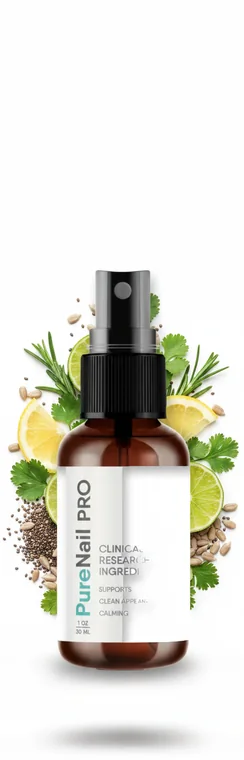
A topical botanical spray works on the visible surface and the cuticle and skin surrounding the nail. That is a genuine cosmetic job: softened cuticles, a cleaner-looking free edge, less of the ragged appearance that makes a hand or foot look neglected. It is not delivering a nutrient to the matrix, and it is not reaching an organism embedded under the plate in any meaningful concentration. A supplement, meanwhile, does reach the matrix but has no ability to sterilise anything. The two approaches are complementary at best, and neither is an antifungal medicine.
The useful question is not which vitamin beats a fungus. It is whether the nail you are about to grow over the next year will be built from a full set of materials or a short one. That is the only part of this you actually control from the kitchen.
What vitamins cannot do, stated plainly
This section exists because most articles on this topic never write it. Here is the limits list, without hedging.
They cannot clear an infection. Dermatophytes living within and beneath the nail plate are not affected by your vitamin D status in any way that resolves the infection. Confirmed onychomycosis is managed with prescription oral or topical antifungals, sometimes with debridement of the thickened nail, and it still fails or recurs in a meaningful proportion of cases. That is the honest state of the field even with real medicine.
They cannot diagnose the problem for you. Several conditions produce a thick, discoloured, crumbling toenail. Nail psoriasis, old trauma from footwear or sport, lichen planus and simple age-related thickening all get mistaken for fungus, and fungus gets mistaken for them. Laboratory confirmation exists precisely because clinical appearance is unreliable. Self-treating the wrong condition for a year is a real cost, which is where our step-by-step guide to what to do about a thick, yellow toenail starts.
They cannot help if you were never deficient. This is the least popular sentence in nutritional writing and one of the truest. The benefit of correcting a deficiency does not extend upward into surplus. Taking more zinc than you need does not build a better nail; it can interfere with copper absorption. Iron in someone who is iron-replete is not benign.
They cannot outrun the environment. Reinfection is common, and the usual reasons are mundane: damp shoes, shared floors, nails cut too short, footwear that traumatises the toe repeatedly. No nutrient offsets a shoe that keeps injuring the nail matrix.
Safety note: this article is general information, not medical advice. Do not start high-dose supplements without speaking to a clinician, particularly if you are pregnant, nursing, taking medication, managing diabetes or living with reduced circulation in the feet. Tell your doctor about biotin before blood tests, because it can distort some assay results.
A sensible way to approach this
If you want a practical order of operations, it looks like this. First, get a diagnosis rather than assuming. A clinician can confirm whether what you are looking at is fungal at all, and that single step changes everything that follows. Second, if there is a plausible reason to suspect a nutritional shortfall, whether that is heavy periods, a restrictive diet, limited sun exposure, coeliac disease or bariatric surgery, ask for the relevant blood tests and correct what is actually low. That is targeted nutrition rather than hopeful nutrition.
Third, sort out the environment. Dry the feet properly, rotate footwear so shoes can dry out fully between wears, use sandals in shared changing rooms, and keep nails trimmed straight across but not so short that the corners dig in. This is unglamorous and it matters more than most supplements. Searches for the best fungal nail treatment natural options usually skip past it entirely, which is a shame, because it is the part that is free.
Fourth, if you want a cosmetic topical for the look and feel of the nail and the skin around it, choose one that describes itself honestly. That is where a botanical spray belongs in this picture: as grooming support with a clear ingredient list, not as a medicine wearing a plant costume. You can read our full breakdown of what PureNail PRO contains and what its ingredients are supported to do before deciding whether it fits what you actually need, or go line by line through every ingredient on the PureNail label and the evidence behind each one.
Finally, set the clock correctly. Give any change, nutritional or topical, at least one full growth cycle before judging it, and judge it by the new nail at the base rather than by the old nail at the tip. That is not a marketing delay tactic. It is simply how nails work.
Scientific references
- NIH Office of Dietary Supplements — Biotin fact sheet for health professionals
- Mayo Clinic — Nail fungus: symptoms and causes
- NIH Office of Dietary Supplements — Zinc fact sheet for health professionals
- Harvard T.H. Chan School of Public Health — B vitamins
- Hochman L.G. et al. — Brittle nails: response to daily biotin supplementation, Cutis (1993)
PureNail PRO: the botanical side, described honestly
A topical cosmetic spray of tea tree, lavender, aloe and jojoba oils for the appearance and condition of nails and the skin around them. Full ingredient list, evidence notes and current pricing on the official page.
Check Availability and Pricing